Reccy makes gear for India's trails, heat, and monsoons — and we're on a mission to help 10 million Indians get out. This piece first ran in our newsletter, Get Out with Reccy. Subscribe on Substack to get the next one first.
Most people who’ve been to Nagaland went in December.
Hornbill Festival. The gathering of all Naga tribes at Kisama Heritage Village — tribal dances, traditional music, extraordinary cultural spectacle. It’s worth every bit of its reputation. If you haven’t been, go.
But 25 kilometres from Kohima, behind Japfu Peak, at the end of a steep forest trail, there is a valley that most of those December visitors never knew existed. And the best time to see it isn’t December.
It’s June and July.
What Dzukou Valley Actually Is
A rolling high-altitude valley at 2,452 metres, straddling the Nagaland-Manipur border. No roads. No vehicles. Only accessible on foot.
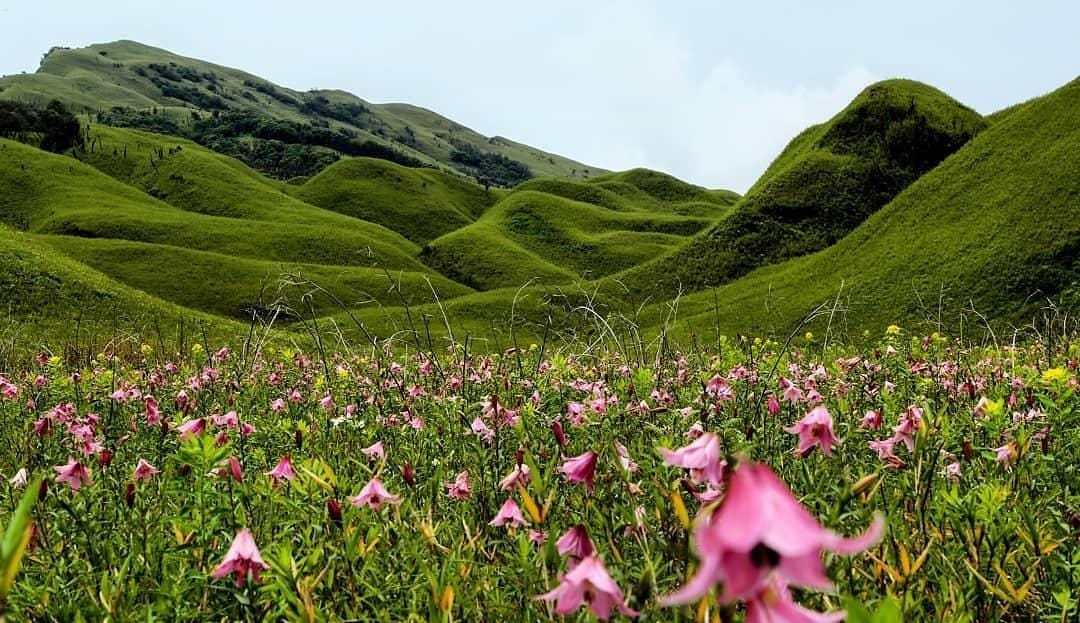
What makes it immediately arresting is the topography. The valley floor isn’t flat — it rolls. Low mounds of dwarf bamboo and meadow grass rise and fall as far as you can see in every direction, like a quilt pulled across the hills. The sky is enormous. From late May through July, the entire landscape is carpeted in wildflowers.
And somewhere in those higher reaches blooms a pink and white lily that exists nowhere else on earth.
Why June–July (Not December)
The Hornbill Festival brings thousands of people to Kohima in December. The valley itself is brown, dry, and flowerless. Most visitors who go in December call it beautiful. People who’ve been in both seasons are honest about it: December is not the valley’s season.
June and July is what Dzukou was made for.
The Dzukou Lily: The valley’s most extraordinary resident blooms from late May through July. A pink lily discovered only in 1991 by a Manipur University researcher — named after his mother — that exists only in this valley. Not anywhere else in Nagaland, not in Manipur, not anywhere on the planet. The Botanical Survey of India published a formal flora survey of this valley in 2016. That’s how ecologically significant it is.
The flowers: Beyond the lily, rhododendrons, euphorbias, anemones, and hundreds of other wildflower species cover the valley floor. The rolling bamboo-green hills dotted with colour look unlike any landscape in India.
The solitude: December brings trekkers combining the valley with the festival. June and July, you’re mostly sharing it with the birds, the streams, and the people who maintain it.
The cold water: The valley is named for the stream that runs through it — Dzukou means cold water in the Angami and Mao languages. In June, that stream is flowing clear and freezing. You’ll want to put your feet in it.
The Flower That Exists Only Here
In the summer of 1991, Hijam Bikramjit was trekking this valley as part of a Manipur Cultural Integration Conference team. He found a lily growing on the higher slopes he’d never seen before. The scientific community hadn’t either.
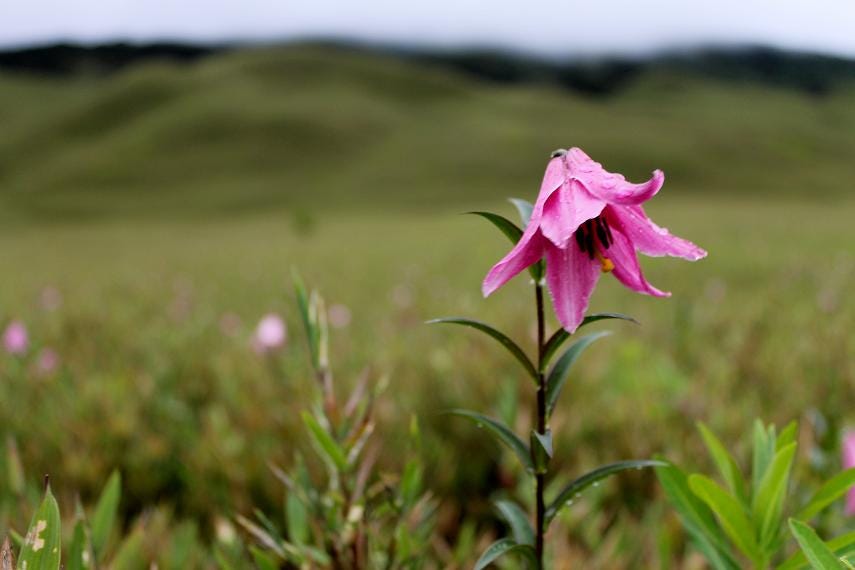
He named it Lilium chitrangadae — after his mother, Chitrangada.
It cannot be cultivated elsewhere. It grows only here, on the higher reaches of this valley, at around 2,400 metres, in these specific conditions of soil, climate, and altitude. Once a year, in June and July, it blooms pink and white. Then it’s gone until the following summer.
The valley is also home to Blyth’s Tragopan — the state bird of Nagaland, confirmed present here. The Hoolock Gibbon. The clouded leopard. A horned toad named after the valley — Megophrys dzukou — because it too exists nowhere else.
This is not a pretty mountain meadow. It is an ecological singularity.
The Trek
From Kohima, a shared taxi takes you 25km to Viswema village. From there, a local vehicle or a long walk takes you up 8-9km of rough motorable road to the trekker’s starting point.
Then the real walking begins.
Viswema route (recommended for first-timers): 1km of steep stone-carved stairs cut into the hillside through dense forest — bamboo canopy above, cold and dark, the climb that tests your legs. Then suddenly, at the top of the ridge, the valley opens. After that, a mostly flat 4-5km walk along the valley slope, crossing small streams, leads you to the SAYO guest house. One-way: 4-5 hours. Moderate difficulty.
Jakhama route (shorter but steeper): 10km, around 4 hours. A more demanding climb almost the entire way. Better used as a descent route.
The circuit most trekkers recommend: Enter via Viswema, exit via Jakhama. You see both sides of the approach and the valley descent via Jakhama is faster.
What trekkers describe at the ridge moment isn’t the view, exactly. It’s the silence. The wind. The sense of stepping into something that doesn’t know or need you.
Minimum time: 2 days. 3 is better — one full day in the valley to actually walk it, find the lily, follow the stream, sit in the silence.
The People Who Look After It
The Southern Angami Youth Organisation — SAYO — is the reason this valley is in the condition it is.
Young people from the Angami Naga communities around Kohima who maintain the guest house, staff the entry checkpoint, conduct rescue operations when trekkers get lost in bad weather, and enforce the rules that keep the valley intact. When visitors have caused wildfires through negligence, it is SAYO volunteers who fight them — alongside forest officials and, when necessary, the Indian Air Force.
The valley recovered from exactly such a fire earlier this year. SAYO contained it over 25 days and reopened the trek in February 2026. June-July this season will be the first post-fire Dzukou Lily bloom. SAYO has expressed hope that the wildflower season will accelerate ecological recovery. It will be worth witnessing.
Since October 2025, a SAYO-registered local guide is mandatory for all trekkers. This isn’t paperwork. It came after repeated rescue operations for trekkers who got stranded without guides on trails that, in monsoon, look nothing like the dry-season photographs. Hire one. They know the terrain, the weather patterns, the history of the valley, and the stories the place holds. That knowledge is most of the experience.
The valley has been a plastic-free zone since 2019. If you arrive with plastic bags, you pay a security deposit refunded only when you leave carrying them out. The streams here are drinking water. Come accordingly.
What to Eat
Naga food is unlike anything else in India. Bold, fermented, smoked. Built around pork, bamboo, and fire.
At the valley: The SAYO guesthouse serves simple meals — rice, dal, vegetables, noodles. Basic and exactly right after a day of trekking. Carry your own snacks for the trail.
In Kohima (the night before and after):
Smoked Pork with Bamboo Shoot — The essential Naga dish. Pork smoked over wood for hours, slow-cooked with fermented bamboo shoots. Earthy, smoky, and unforgettable. Try it at The Hut (NH 61) or Chingtsuong Restaurant (Razu Point area — known specifically for traditional Angami cuisine).
Galho — The Angami people’s comfort food. Rice cooked down into a thick, warm porridge with greens and smoked meat. The equivalent of coming home. Available at most local eateries and homestays in Kohima.
Axone pork curry — Axone is fermented soybean, pungent and deep. Cooked with pork it becomes something entirely its own. Try it at Amaris (Jail Colony, Kohima) which has Axone Pork Curry as their signature dish.
Zutho — Traditional Naga rice beer. Mildly alcoholic, slightly cloudy, brewed locally. The social drink of the hills. Refusing it is rude. Accepting it graciously is the right move.
The best food in Kohima is in local kitchens, not restaurants. If your host offers to cook, say yes to everything.
Where to Stay
At the valley: The SAYO-maintained guest house has two basic dormitories — one wooden floor, one concrete. Caretakers provide blankets, mats, and basic bedding. One private cottage with an attached bathroom is available for those who want it. Camping is permitted in designated areas. No luxury, no Wi-Fi, no phone signal. That’s the point.
Before the trek — in Kohima: Stay the night before at a guesthouse in Kohima or, better, in Kigwema village (17km from Kohima, right at the base of the trek approach). Kigwema is an Angami village — waking up there and walking to the trailhead at dawn is a better start than rushing from Kohima in the morning.
Budget for Kohima accommodation: ₹800-1,500/night with meals at a guesthouse or homestay.
How to Get There
Dzukou isn’t simple to reach. That’s partly why it’s still real.
Step 1: Fly to Guwahati Direct flights from Mumbai, Delhi, Bangalore, Kolkata. Guwahati is the Northeast’s main hub.
Step 2: Guwahati to Dimapur
- Train: Nagaland Express from Guwahati to Dimapur — 4-5 hours, well-connected. ₹300-500 sleeper class.
- Flight: Dimapur Airport has direct flights from Kolkata and Guwahati. ₹2,000-4,000.
Step 3: Dimapur to Kohima
- Shared taxi/Tata Sumo from Dimapur railway station exit: ₹400-500 per person, 3-4 hours.
- Private taxi: ₹3,500-4,000.
Step 4: Kohima to Viswema
- Shared yellow sumo from Network Travels AOC Bus Stand (not the NST stand where you arrive from Dimapur — these are different): ₹50 per person. Wait 30-45 minutes for vehicle to fill.
Step 5: Viswema to trekker’s starting point
- Local taxi: ₹1,500-2,000 for 8-9km up the motorable road.
- Or walk the motorable road (adds 2-3 hours).
ILP — Mandatory
All Indian citizens from outside Nagaland need an Inner Line Permit to enter the state.
- Apply online: ilp.nagaland.gov.in
- Processing: Within 4 hours on working days if applied online.
- Cost: ₹200 per person.
- Documents needed: Government photo ID (Aadhaar/Voter ID/Passport) + two passport photos.
- Can also be obtained at Nagaland House offices in Delhi, Kolkata, Guwahati, and Shillong, or at Dimapur and Kohima on arrival.
Apply before you travel, not after you land.
What to Pack
- Rain gear — non-negotiable for June-July. Trails are wet and the valley is exposed.
- Layers — mornings and nights at 2,452m are cold regardless of season. A fleece minimum.
- Waterproof trekking shoes with grip. The steep sections are slippery in wet conditions.
- Cash from Kohima. No ATMs near the valley or at the guest house. Carry enough for 3 days of food, fees, and guide.
- 2 litres of water minimum on trail — streams exist but carry your own.
- No single-use plastic. The valley declared itself plastic-free in 2019. Carry a reusable bottle and carry all your waste out.
- First aid basics and any personal medication — nearest pharmacy is in Kohima.
The Real Cost
4 days / 3 nights from any major city:
Return flights to Guwahati ₹5,000–10,000
Guwahati–Dimapur train ₹300–500
Dimapur–Kohima shared taxi ₹400–500
ILP ₹200
Kohima accommodation (1 night) ₹800–1,500
Kohima–Viswema shared sumo ₹50
Viswema to trekker’s point taxi ₹1,500
SAYO entry fee + camera fee ₹300
Valley accommodation (2 nights) ₹400–600
Valley meals ₹600–800
Local guide (mandatory) ₹500–1,000/day
Kohima food (1 day) ₹400–600
Total per person ₹12,000–18,000
The working professional’s version:
Fly Thursday night from Mumbai/Bangalore.
Friday morning in Dimapur, Kohima by afternoon.
Saturday trek up, night in valley.
Sunday valley exploration, trek down.
Monday fly home.
Back at your desk Tuesday.
Total: ₹15,000–20,000.
Total damage to soul: zero.
Why Bother
Because India has very few places left where:
The wildflowers aren’t a backdrop — they’re the whole point. A lily that exists only here. A bloom window of six weeks a year. This isn’t a garden. It’s a biological event.
The community is the experience. SAYO isn’t a ticketing system. It’s young Angami Nagas who have chosen to steward this valley for the people who come after them. Your guide isn’t a service — they’re a person with more knowledge of this terrain than you will ever have. The relationship matters.
The silence is real. No connectivity in the valley. No distraction from what’s in front of you. Just wind, cold water, rolling green, and a sky so dark at night that people consistently describe shooting stars in their first ten minutes of looking up.
You’re a guest, not a customer. This valley has been home to the Angami and Mao Naga communities long before trekkers arrived. Come with that understanding. Ask before photographing. Carry everything out that you brought in. Leave the valley exactly as you found it, or better.
Dzukou is changing — the mandatory guide rule, the plastic-free zone, the SAYO infrastructure — all of it is an attempt to manage growth without losing what makes the place worth visiting. Whether that works depends partly on the visitors it receives.
Go carefully. Go curiously. And then tell people what’s there — because the best protection a place like this has is people who understand what it actually is.
Reccy doesn’t organize trips to Dzukou Valley. We don’t sell packages or permits. We believe responsible travel means supporting local communities, minimizing your impact, and approaching places like this with the seriousness they deserve — as guests, not spectators.
Get Out.
